

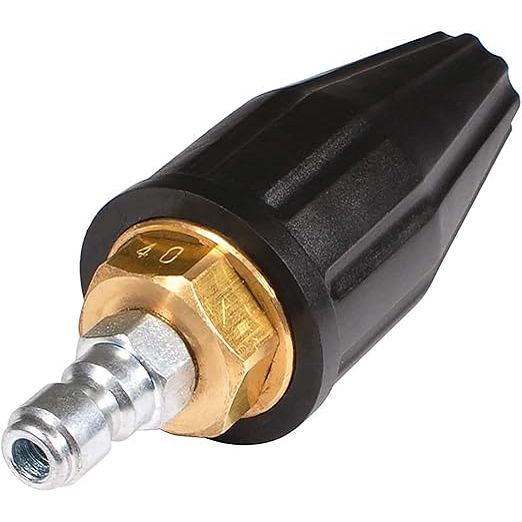
High Pressure Turbo Nozzle
The High Pressure Turbo Nozzle is a rotary pressure washer attachment for heavy-duty cleaning of hard surfaces. It combines a concentrated water jet with continuous rotary movement and is configured for compatible electric pressure washing equipment operating at 1000–4000 PSI.
Description
The High Pressure Turbo Nozzle is a rotary pressure washer attachment for heavy-duty cleaning of hard surfaces. It combines a concentrated water jet with continuous rotary movement and is configured for compatible electric pressure washing equipment operating at 1000–4000 PSI.
Technical Specifications
|
Parameter |
Specification |
|
Product Type |
High Pressure Turbo Nozzle |
|
Orifice Diameter |
4.0 mm |
|
Design Flow |
4.0 GPM |
|
Recommended Pressure |
1000–4000 PSI |
|
Maximum Working Pressure |
4000 PSI |
|
Inlet Connection |
1/4" Quick Connect |
|
Turbine Material |
Ceramic |
|
Protective Material |
Rubber |
|
Connecting Parts |
Brass |
|
Body Material |
Aluminum Alloy |
|
Spray Type |
Rotary Concentrated Jet |
|
Equipment Application |
Electric Pressure Washer |
|
Cleaning Duty |
Heavy-Duty Surface Cleaning |
Selection Note
The pressure washer's actual working pressure, flow rate, orifice requirement, and connection type should be checked before selecting the nozzle.
Key Features
Controlled Flow Configuration
The 4.0 mm orifice and 4.0 GPM design flow establish the flow conditions required for the rotary jet.
Ceramic Rotary Turbine
The internal turbine converts incoming water flow into continuous rotary movement, allowing the concentrated jet to sweep across the surface.
Lightweight Aluminum Alloy Housing
The aluminum alloy housing encloses the internal assembly while keeping the nozzle suitable for handheld pressure washing equipment.
Protected Rotary Assembly
The external rubber layer provides physical protection around the internal rotary components during normal handling and operation.
Quick-Connect Interface
The 1/4-inch quick-connect interface supports rapid installation and replacement on compatible pressure washer equipment.
Rotary Cleaning Pattern
The rotating jet repeatedly moves concentrated water impact across the working area instead of keeping the jet fixed at one point.
Component Configuration
The GTM High Pressure Turbo Nozzle is assembled from several structural sections, including the inlet section, internal rotating unit, spray outlet, and external housing.
Inlet Section
The inlet section connects the turbo nozzle with compatible pressure washer accessories and provides the entry point for pressurized water.
Internal Rotating Unit
The internal rotating unit is installed inside the nozzle body as the main rotating assembly within the turbo nozzle structure.
Spray Outlet Section
The outlet section forms the final discharge opening of the nozzle assembly and is configured according to the selected nozzle specification.
Nozzle Housing
The housing encloses the internal components and maintains the overall assembly alignment during installation and operation.
Applications
Construction & Equipment Maintenance
Used by cleaning and maintenance operations to remove mud, clay, soil, and accumulated debris from excavators, loaders, agricultural machinery, construction equipment, and other heavy-duty equipment.
Industrial Cleaning
Used for cleaning production equipment, industrial machinery, maintenance areas, loading zones, and other hard surfaces affected by heavy dirt and deposits.
Facility & Floor Maintenance
Used for removing embedded dirt, mud, deposits, and surface contamination from concrete floors, garage floors, workshops, loading areas, and industrial facilities.
Tank & Vessel Maintenance
Used for external cleaning of compatible metal and plastic tanks, vessels, and containers where the surface can withstand high-pressure rotary cleaning.
Marine Cleaning
Used for removing dirt, mud, and surface deposits from compatible boat hulls and other suitable marine surfaces.
Infrastructure Cleaning
Used for cleaning compatible roads, paved areas, masonry, and other hard infrastructure surfaces affected by accumulated dirt, mud, and deposits.
Surface Coating Removal
Used for selected paint and coating removal applications where the substrate can withstand concentrated high-pressure water impact. A small test area should be evaluated before full-surface treatment.
Turbo Nozzle vs. Fixed Spray Nozzle
|
Feature |
Turbo Nozzle |
Fixed Spray Nozzle |
|
Jet Movement |
Rotary |
Fixed |
|
Cleaning Pattern |
Circular moving pattern |
Fixed or fan pattern |
|
Water Impact |
Repeatedly moves across the surface |
Remains within the selected spray area |
|
Cleaning Duty |
Heavy surface contamination |
General or targeted cleaning |
|
Operator Movement |
Sweeping passes |
Point or fan-pattern control |
Production Process
The High Pressure Turbo Nozzle is produced through controlled machining, assembly, functional testing, and final inspection.
Material & Component Preparation
Specified materials and components are prepared according to the approved product configuration.
Housing & Orifice Processing
The nozzle body and orifice are machined to the required dimensions and tolerances.
Turbine & Component Assembly
The internal turbine, protective components, and connection parts are assembled according to the approved structure.
Functional Testing
Completed nozzles undergo leakage and rotary operation checks before final inspection.
Final Inspection & Packaging
Products are inspected against the approved specification and packed according to order requirements.
Quality Control Process
GTM checks critical dimensions, materials, assembly condition, leakage, and rotary operation against the approved product configuration.
Material Inspection
Specified ceramic, rubber, brass, aluminum alloy, and other components are checked against the approved configuration.
Dimensional Inspection
Critical orifice, housing, and connection dimensions are checked against the approved specifications.
Assembly Inspection
The turbine, protective components, connections, and sealing parts are checked during assembly.
Leakage & Rotary Testing
Completed nozzles are checked for leakage and abnormal turbine rotation under the specified test conditions.
Final Inspection
Finished products are checked for configuration, connection condition, assembly status, appearance, and packaging before shipment.
Why Choose GTM
High-Pressure Expertise
Specialized in high-pressure plunger pumps and pressure washing equipment since 1997, with experience across high-pressure water systems.
Manufacturing Capability
GTM operates a 20,000㎡ facility with 150+ employees and produces 90+ product models covering pumps, pressure washers, components, and cleaning accessories.
R&D Capability
GTM holds 80+ patents and develops high-pressure equipment and related components for different application requirements.
OEM Capability
OEM orders can be produced to agreed specifications, including product configuration, identification, and packaging, with technical and after-sales support for international customers.
FAQ
Hot Tags: high pressure turbo nozzle, China high pressure turbo nozzle manufacturers, suppliers, factory
Send Inquiry
You Might Also Like


