


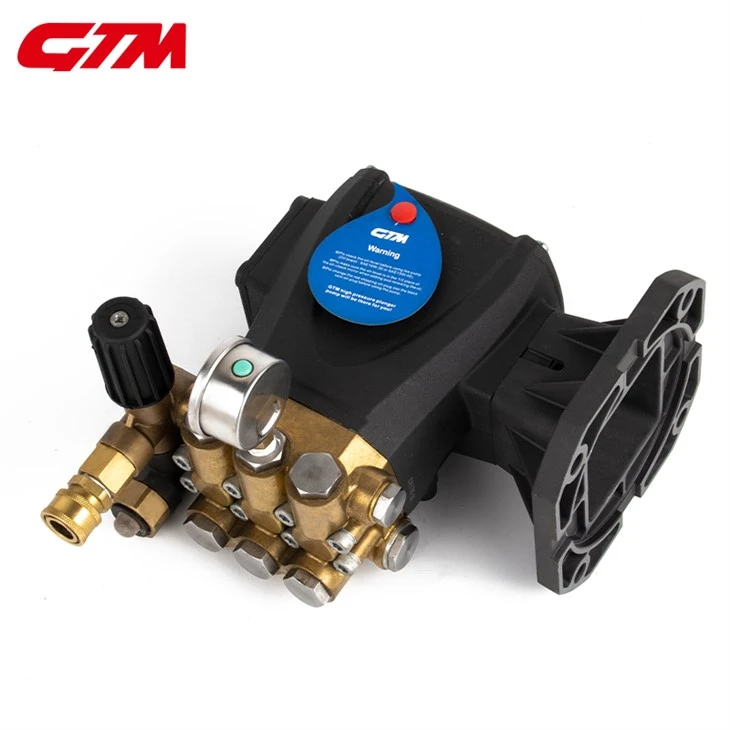

Electric Plunger Pump
The GTM Electric Plunger Pump is an electric motor-driven high-pressure plunger pump for clean-water applications, using a reciprocating plunger system for positive-displacement fluid delivery.
Description
The GTM Electric Plunger Pump is an electric motor-driven high-pressure plunger pump for clean-water applications, using a reciprocating plunger system for positive-displacement fluid delivery.
Technical Specifications
|
Model |
Flow |
Max. Pressure |
Power |
Speed |
|
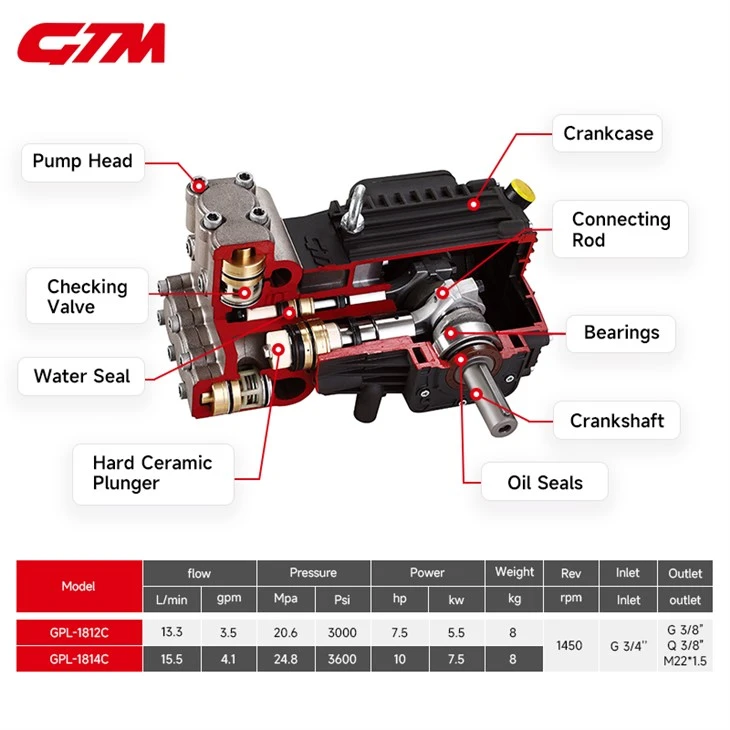
GPL-1812C |
13.3 L/min / 3.5 GPM |
3,000 PSI |
5.5 kW / 7.5 HP |
1450 RPM |
|
GPL-1814C |
15.5 L/min / 4.1 GPM |
3,000 PSI |
7.5 kW / 10 HP |
1450 RPM |
Maximum pressure depends on the final pump configuration and operating conditions.

Key Features
Electric Motor Drive
The electric motor provides direct mechanical drive without requiring a compressed-air supply.
Low-Noise Operation
The electric drive avoids pneumatic air discharge, helping reduce operating noise in enclosed working areas.
No Combustion Exhaust
The electric drive produces no combustion exhaust, making the pump practical for indoor installations.
Wear-Resistant Pump Components
Selected stainless steel and ceramic components are used in the pump assembly for high-pressure clean-water service.
Straightforward Service
Accessible service points allow routine inspection of the inlet filter, valves, seals, packing, and lubrication points.
Pump Construction
Reciprocating Plunger
The plunger creates the suction and discharge cycles required for positive-displacement high-pressure pumping.
Pump Valves
Inlet and outlet valves control fluid movement through the pumping chamber during each reciprocating cycle.
Sealing System
Packing and seals control fluid leakage around the reciprocating plunger and require inspection according to operating conditions.
Wetted Components
Fluid-contact components are selected according to the pumped medium, temperature, pressure, and material compatibility.
Typical Applications
Commercial & Industrial Cleaning
High-pressure water delivery for factory equipment, production lines, machinery, floors, and commercial facilities.
Professional Vehicle Care
High-pressure water supply for vehicle washing, detailing, service centers, and commercial vehicle cleaning facilities.
Agriculture & Animal Husbandry
High-pressure water supply for greenhouse cleaning, farm equipment washing, and facility disinfection.
Municipal & Property Maintenance
High-pressure cleaning for parking areas, building exteriors, paved surfaces, and public facilities.
Water Treatment & RO Systems
High-pressure water supply for selected reverse osmosis, water treatment, and circulation systems where pump conditions match the application requirements.
Operating Conditions
Pumping Medium: Designed primarily for clean water and water-based fluids compatible with the selected wetted materials.
Inlet Supply: The inlet system should provide sufficient fluid supply without excessive restriction or air entering the suction line.
Duty Cycle: Operating hours, pressure level, and duty cycle should be considered when selecting the pump and motor configuration.
Fluid Compatibility: Fluid temperature, chemical concentration, suspended solids, and material compatibility should be confirmed before operation.
Configuration & OEM Integration
Electric Drive
Motor power, voltage, frequency, phase, and motor configuration can be specified according to the installation requirements.
Connections
Inlet and outlet connection types can be reviewed according to the existing high-pressure system.
Wetted Components
Plunger, valve, packing, seal, and other fluid-contact components can be reviewed according to the pumping medium.
Replacement & OEM Integration
Existing pump model, nameplate data, connection dimensions, operating pressure, flow, motor requirements, and operating conditions can be reviewed for replacement or OEM integration.
Quality Control and Testing
GTM applies quality control procedures covering component inspection, machining verification, assembly control, and performance testing to verify electric plunger pump quality before shipment.
Component Inspection
· Pump body and structural components
· Plunger, valve, and sealing components
· Bearings and transmission parts
· Motor matching specifications
· Material and dimensional requirements
Precision Machining Inspection
· Pump body machining dimensions
· Shaft and bore tolerances
· Thread accuracy
· Sealing surface condition
· Component fit verification
Assembly Inspection
· Plunger and seal installation
· Valve assembly condition
· Drive system connection
· Fastener tightening
· Motor and pump alignment
Performance Testing
· Pressure output verification
· Flow rate inspection
· Leakage testing
· Rotation direction checking
· Motor operation verification
· Vibration and operating noise inspection
Final Inspection Before Shipment
· Pump configuration confirmation
· Appearance inspection
· Accessories verification
· Product documentation review
About GTM
Established in 1997
GTM specializes in high-pressure plunger pumps, pressure washers, and related cleaning equipment, with manufacturing experience dating back to 1997.
20,000㎡ Production Facility
The manufacturing base supports production, engineering, inspection, and assembly with a team of 150+ employees.
90+ Product Models
GTM develops and manufactures more than 90 models of high-pressure pumps and cleaning equipment for different application requirements.
80+ Patents
GTM's product development portfolio includes more than 80 patents covering its high-pressure pump and cleaning equipment technologies.
Global OEM Support
GTM provides OEM customization, technical support, and after-sales service for international customers.
FAQ
Hot Tags: electric plunger pump, China electric plunger pump manufacturers, suppliers, factory
Send Inquiry
You Might Also Like


